
The food import climate risks show why we need to adapt now to protect businesses and supply chains. Here’s the top-level risk map. Spoiler: it’s not reassuring.
Source: Home | Substack
We know climate change will impact food supply chains — and many of the nations we depend on for products like coffee, cocoa, and tea will be among the most critically affected. But what are the risks? You need to know these to act and plan. We’ve developed methods to do exactly that.
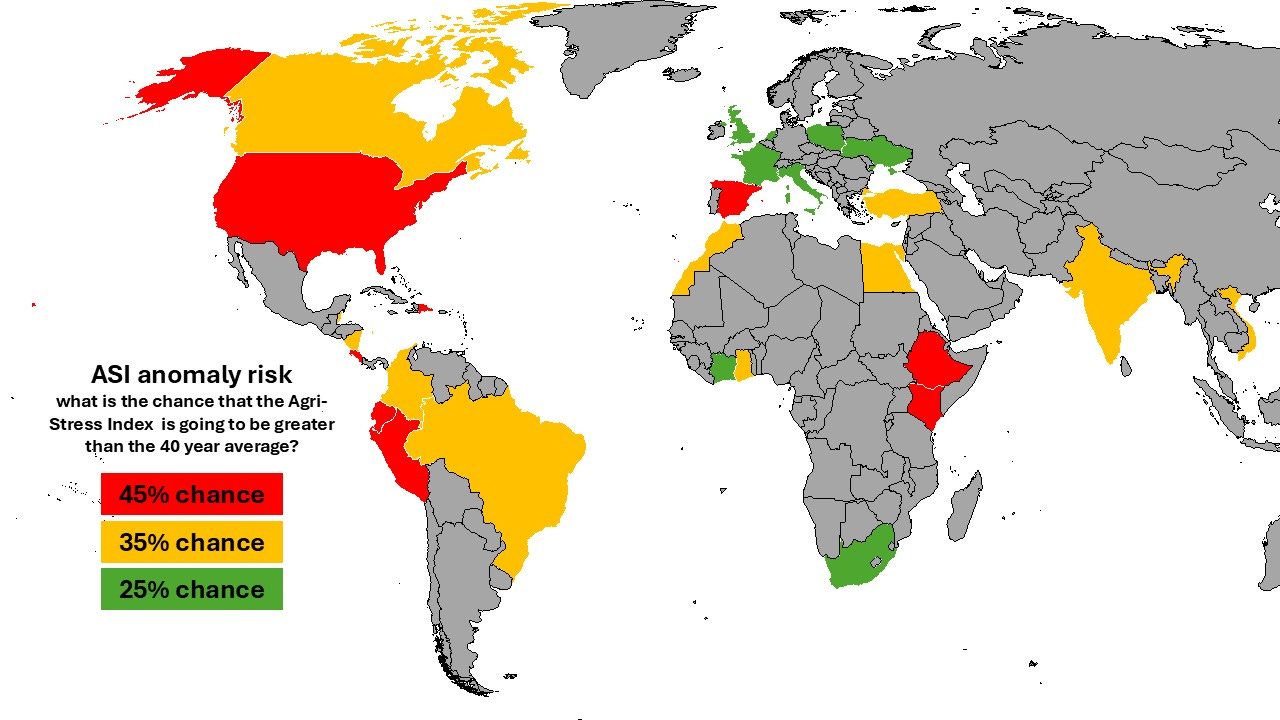
We use the Agricultural Stress Index (ASI) to assess national climate risks for the UK’s key imported commodities — from soybeans and fresh produce like bananas and oranges to essential botanicals like coffee and tea.
Here’s the top-level risk map. Spoiler: it’s not a good look.
These are products the UK diet depends on. And in this system, a 25% chance of agricultural stress exceeding the long-term average is considered a good outcome.
That’s a 1 in 4 risk of severe supply disruption. Of course, models have gaps — but the ASI gives national-level granularity by tracking how much agricultural land has vegetation health below 35%. That’s a lot to think about.
It’s time to stop guessing and start planning.
👉 If you want to understand what this risk means for your sector — let’s talk.
 Dr Wayne Martindale, FIFST