
MPCR GreenEye applications map crop and forage production using Earth observation to quantify food security and supply risks for commercial agricultural enterprises. Using satellite data and biochemical modelling, we can assess fixed carbon, stored carbon, water used and nitrogen utilised by crop canopies. By tracking real-time change in these indicators and combining them with weather data we can reduce agricultural production risks. Weather data going back to the 1980s can now provide more confident projections that are designed to support truly climate-ready production.
Why an API? Turning Reporting into Action
The GreenEye API grew out of the growing demand for land-use and crop-water reporting. Policymakers are rightly concerned about these issues, but the information rarely reaches the people who need to act on it most in a way that provide answers to their questions: agronomists and supply-chain decision makers.
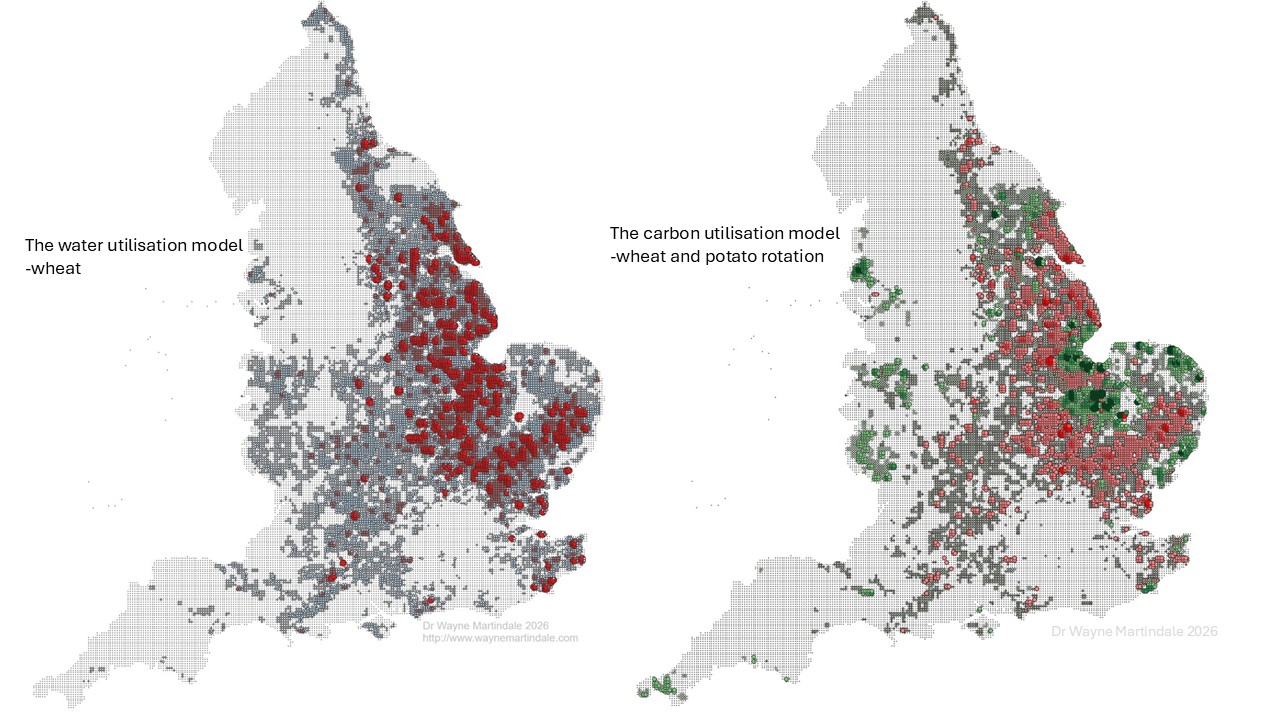
Water is the clearest example. In many regions, water availability is already in deficit for secure crop production. Our recent UK wheat analysis shows that in the highest-intensity areas, more than 0.3 million tonnes of water per square kilometre are transpired by the crop during a single sow-to-harvest cycle. Balancing this demand with available surface water and aquifer supply is becoming tighter every year.
The urgency is clear: we need to move from awareness to action. Our API is designed to pinpoint where intervention will have the greatest impact.
From Water to Carbon: Discovering the Missing Piece
As we prepared this water-use model for release, we began testing a companion carbon model—tracking both photosynthetic carbon capture and carbon stored in crop dry matter. This work exposed major gaps in how agricultural production is typically assessed. Most farming systems are built around crop rotations developed to maintain soil fertility and control disease. Our modelling shows that carbon cycling underpins both of these goals and deserves far greater recognition as a primary driver of sustainable production.
Insights gained from long-term field experiments tell us how carbon sequestration occurs over a full crop or grazing rotation and some of this is well characterised but guiding what to do in real time during a rotation shows where greatest sequestration can be achieved and it is where we have an edge. In short, rotation is not just an agronomic practice—it is a powerful carbon management strategy when timed with productivity and weather changes.
Looking Ahead
GreenEye is about moving from fragmented reporting to integrated, actionable intelligence. By connecting water, carbon, nitrogen and weather data, we aim to give agriculture the tools it needs to respond quickly, manage risk, and build resilience for a changing climate.
 Dr Wayne Martindale, FIFST