
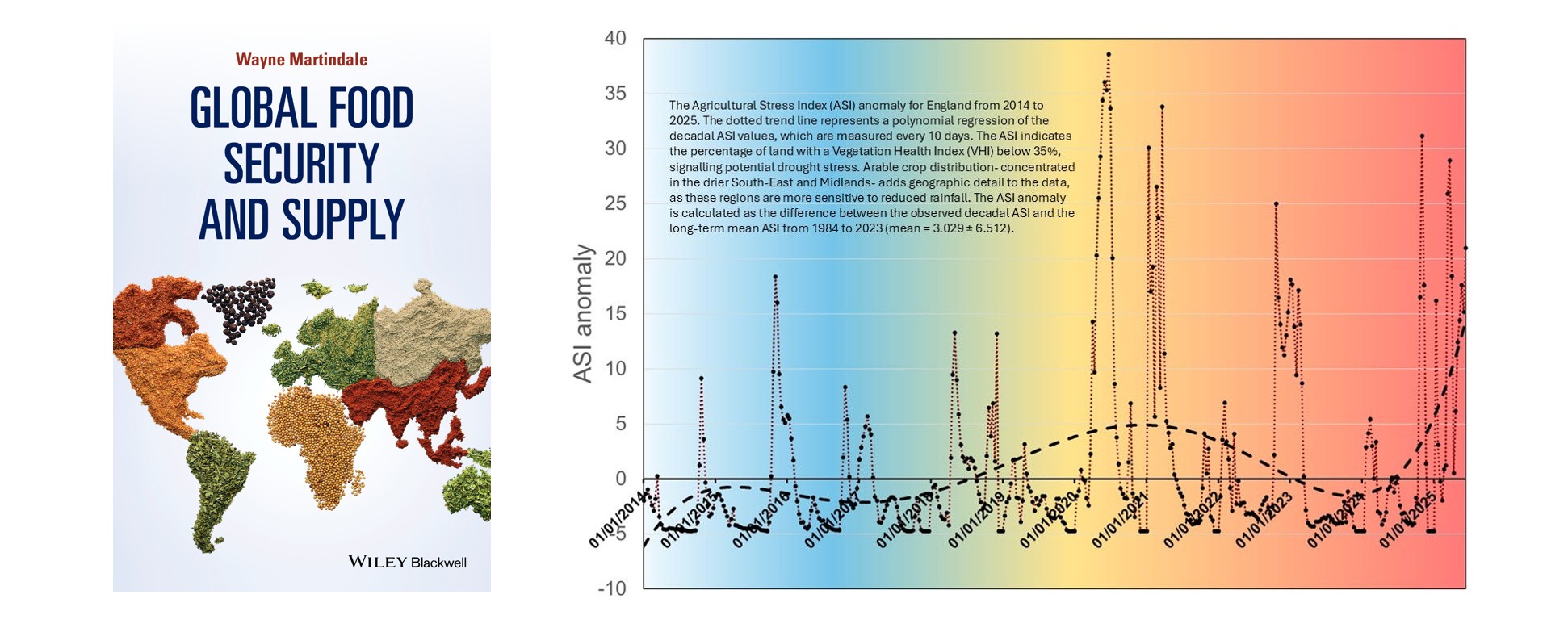
After delivering the OECD conference Delivering Food Security with Supply Chain Led Innovations with the Association of Applied Biologists some 16 years ago, I wrote Global Food Security and Supply. Published in 2014, it remains in print — but the need for an updated edition has never been clearer, and a draft is now ready for review. The 2010 conference contributors sparked the opportunity for my publisher, Wiley, to encourage me to write my first book, following the conference proceedings published as Aspects of Applied Biology 102 — a publication that, in hindsight, was ahead of the food security debate then, and arguably still is.
The global food security challenge has not lessened and effort to break it have certainly changed less than we might hoped since 2014. The most destructive drivers of food security remain armed conflict and regimes that force communities into poverty and fear. Alongside these are slower-burn pressures — climate change, natural resource decline, and economic volatility — that increasingly push the most vulnerable further to the margins.
So the core drivers of food insecurity remain stubbornly familiar: conflict, political instability, climate change, and natural resource decline. Economic pressures in agriculture also feel cyclical — when I started working in agriculture during the late 90s, wheat and ammonium nitrate were around £75 and £90 per tonne in the UK, and today we face new cost pressures that are very different at £150 and over £500 per tonne! While critical control points such as gas supply are evident, the agri-food system as it stands depends upon rare earths, catalysts and specialist materials just as much. Releasing these controls means changing the system and that is not happening in what we would call a transformative way- we are dabbling at the edges of it if anything, with innovations in meat free, biostimulants, carbon capture and any number of these things that are acting in isolation.
A solution and point of focus in the re-write of Global Food Security and Supply is what has changed dramatically during this time. The availability of food supply data has transformed and the agri-food system now has access to more powerful and connected data sources than ever before. The challenge is no longer access, but the skills to ask the right questions and turn information into action. That capability will shape how AI and human expertise secure the future of food. We’re now rewriting the book. The new edition will focus on how the data revolution can help solve global food security — if the sector can skill up and mobilise the talent that can use the data available to it.

