It’s some 28 years since I started out in the agricultural industry working for Levington Agriculture. Since 1998, I must have seen at least 5 to 10 iterations of agricultural carbon storage or sequestration programmes that have all stated they will pay farming innovators for carbon conservation across their farm enterprises. All have shown their pitfalls, pure snake-oil ideas and even downright dastardly scamming.
But I now I’m looking past the skids of carbon credit programmes that have past us by towards the next few years and considering we might now be seeing something that might change such cyclic hyperbole that only benefits the few. This is because we have not only seen a need to reduce carbon emissions over the last 28 years but also have a realisation that so much about carbon conservation practice in agriculture makes sound business sense. This was all well-known to those soil conservation and min-till practitioners, I remember looking over old Fisons data from the 1970’s for min-till and direct drill trial where the results were mixed but carried out on short-term rotations. Now the outlook has changed with fertiliser prices at some 3 to 4 times that of 28 years ago and wheat prices are only dragging theor feet at close to double those 1998 prices. It is this business case that is making agronomists re-look at longer term soil reserves for economic benefit.
The critical start-point for applying this generation-wide store of regenerative agriculture know-how is to use the numbers associated with agronomic yield and productivity. Many of these pre-date the term regenerative and that baseline for change must be carbon capture and we have been implementing this for grassland and arable systems. We now fully understand carbon balances for most agri- production and land management so that the practical working limits for carbon sequestration can be met. Developing a robust mapping methodology to do this meant we not only understood assessment of carbon sinks but also identified optimal water use, biodiversity and other ecosystem services across farms. All of these increase productivity because it works within the limits of the crop-soil yield potential. The baseline for all of this is the capacity of dynamic fixation of carbon by crops or the photosynthetic carbon fixation which changes over a growing season. This carbon can be lost or utilised by metabolism, respiration and structural development which in the case of grass where 70% of biomass is water can be substantial. That brings us to water, the amount of water required for biomass production is metabolically limited and this can also be used to calculate how much water is needed to be transpired for a given yield. All of this is of growing importance with increasingly dry summers and wet springs- planning ahead in such uncertain patterns is an essential part of reducing commercial risk.
Grassland enterprises are of particular interest to us because production strategy can change in an instant of one days and 10 mm of rainfall. Being risk-readied is an edge in agri-business, and our methods make that possible if you are asking the right questions and looking at data in the right way. The scale of water use and residual carbon in these assessments screams at us, ‘where does the water needed come from, is it sufficient and where does that residual carbon go, can it be used’. Also, ‘what happens if residual carbon decreases’?’
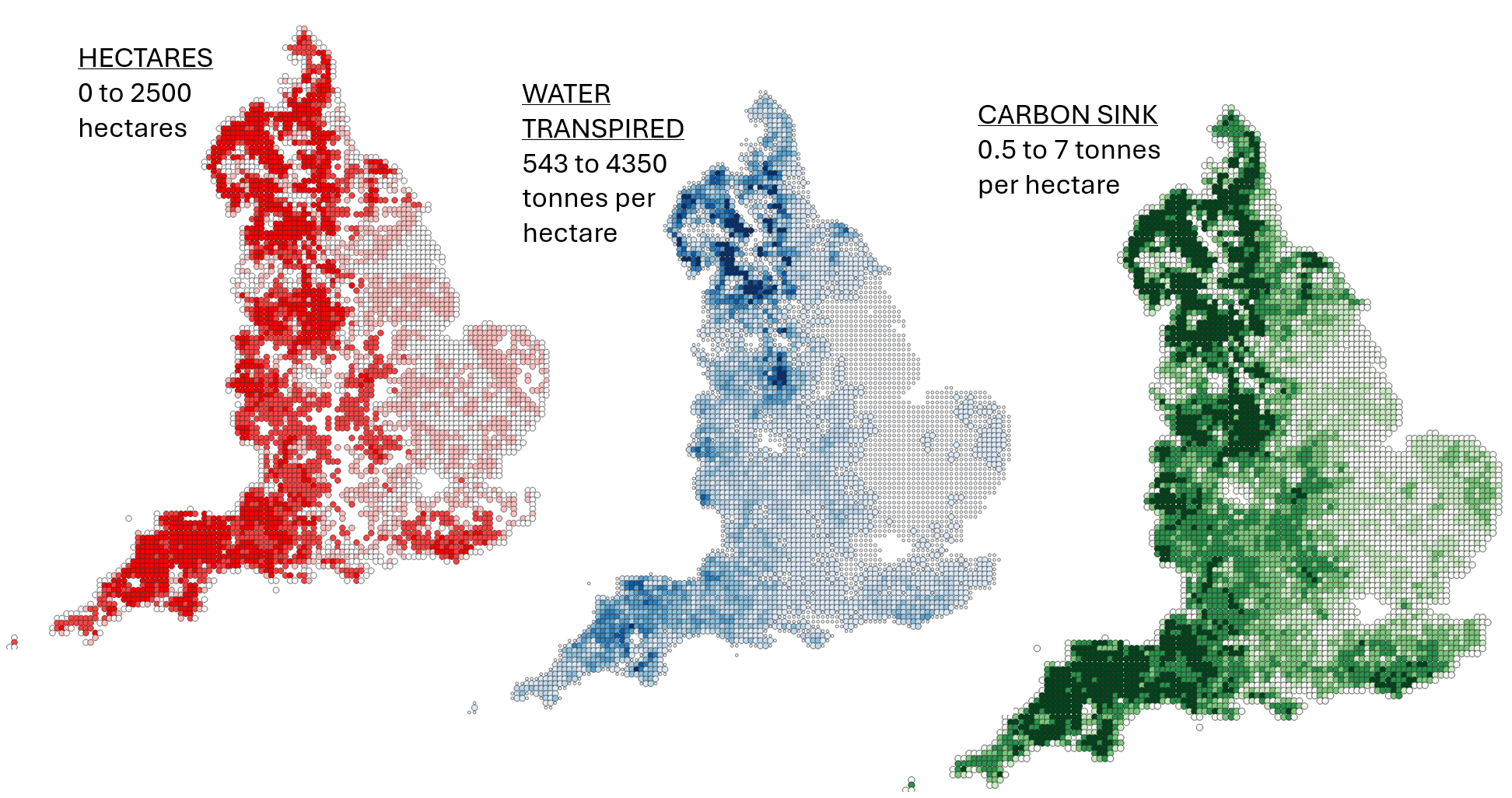
The maps shown here give a carbon surplus of 0.5 to 7 tonnes per hectare in mature grassland over 5 years, where is it going? We practically know what is happening and it relates directly to productivity, it is not a case of muck, mystery or extended research detail here. It is about balance and these concepts are borne from our interest in the first ecosystem paper we saw way back in 1997 from Costanza et al, in their Nature paper we saw how ecosystem service could be calculated and considered within an economic framework. Even further back are the agronomic constants we use and these are the ones we really do stand on the shoulders of others- some of them bigger and more useful than others! What’s more, the really current and bright science is stacking up to our calculations as well, see https://www.nature.com/articles/s41561-026-02103-0, we just want to apply it and grassland is a good start.